

HSE Scientists Test New Method to Investigate Mechanisms of New Word Acquisition

Researchers at the HSE Centre for Language and Brain were among the first to use transcranial alternating current stimulation to investigate whether it can influence the acquisition of new words. Although the authors of the experiment have not yet found a link between brain stimulation and word acquisition, they believe that adjusting the stimulation parameters may yield different results in the future. The study has been published in Language, Cognition and Neuroscience.
The ability to acquire and appropriately use new words is essential for effective human communication. Throughout life, people continue to learn new words in their native language and also master foreign languages. Acquiring new words is a complex cognitive process, and its underlying mechanisms remain poorly understood.
Modern neuroimaging techniques—such as electroencephalography, magnetic resonance imaging, and magnetoencephalography—allow researchers to look inside the brain and observe which regions are activated during specific cognitive processes. However, it remains impossible to determine whether the relationship between stimulation and brain processes is causal or merely coincidental. The use of alternating current in experiments changes the approach: it allows for modulating rhythms at specific frequencies and tracking their role in neural processes.
Researchers at the HSE Centre for Language and Brain were among the first to investigate whether weak electrical stimulation of the brain at the theta frequency can help memorise new words. The scientists recruited 30 healthy volunteers and asked them to learn 80 pseudowords paired with Russian nouns. During the training, participants received low-current brain stimulation at theta rhythm frequencies (3.5–7.5 Hz) over the left frontotemporal regions of the brain, which are associated with speech and memory. The theta frequency band was deliberately chosen, because previous studies have shown that theta rhythms play a key role in transferring information from short-term to long-term memory.
After participants learned the words with stimulation, the researchers tested their memory retention. There was also a separate phase of learning and testing without stimulation to compare participants’ performance.
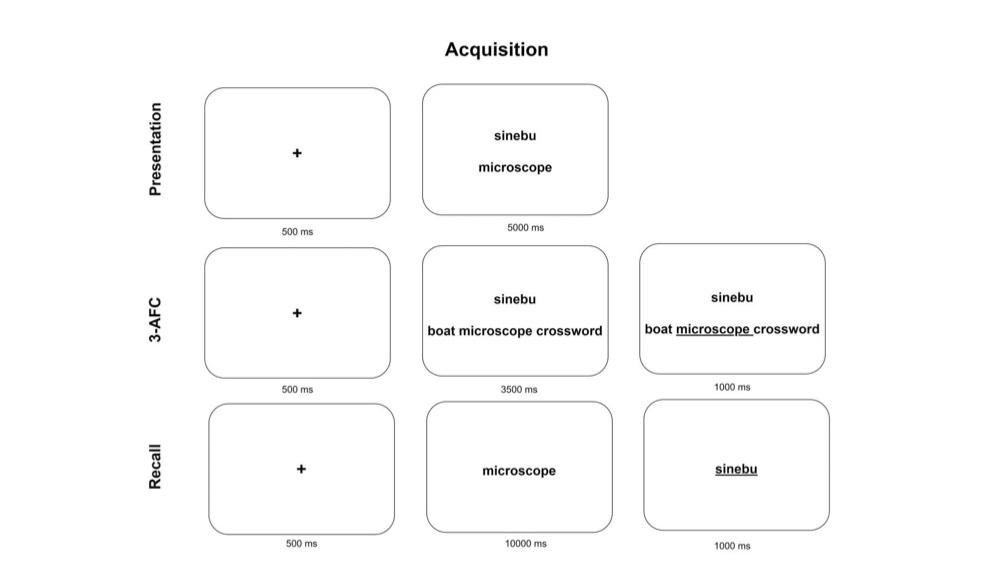
No improvement was observed in new word acquisition with stimulation compared to the control condition. The authors note that learning new words activates complex neural networks involving both the cerebral cortex and the hippocampus, which is difficult to stimulate noninvasively from the surface of the head.

Anna Komissarenko
'Although our study did not find a direct effect of alternating current stimulation on word acquisition, we still made an important step toward developing new methods to support language learning. We will continue our research in this direction, but future experiments will focus on other brain regions and types of stimulation,' explains Anna Komissarenko, Junior Research Fellow at the HSE Centre for Language and Brain and lead author of the paper.
In the future, the team plans to test different frequency bands and phases of electrical stimulation, change electrode placement, and expand the experiments to explore various cognitive functions. This can help deepen our understanding of how the brain’s electrical activity influences learning and memory, potentially leading to the development of accelerated language learning techniques, rehabilitation programmes for stroke and injury patients, and optimised neurostimulation methods to enhance memory.
See also:

Scientists Test Asymmetry Between Matter and Antimatter
An international team, including scientists from HSE University, has collected and analysed data from dozens of experiments on charm mixing—the process in which an unstable charm meson oscillates between its particle and antiparticle states. These oscillations were observed only four times per thousand decays, fully consistent with the predictions of the Standard Model. This indicates that no signs of new physics have yet been detected in these processes, and if unknown particles do exist, they are likely too heavy to be observed with current equipment. The paper has been published in Physical Review D.
HSE Scientists Reveal What Drives Public Trust in Science
Researchers at HSE ISSEK have analysed the level of trust in scientific knowledge in Russian society and the factors shaping attitudes and perceptions. It was found that trust in science depends more on everyday experience, social expectations, and the perceived promises of science than on objective knowledge. The article has been published in Universe of Russia.
Institute for Robotics Systems Established at HSE University
As decided by the HSE University Academic Council, a new Institute for Robotics Systems will be established at HSE, and with a strong fundamental base. It will cooperate with relevant departments across the university and engage students and doctoral candidates in research and development (R&D). First Vice Rector of HSE University and Director of the Institute for Statistical Studies and Economics of Knowledge, Leonid Gokhberg, discussed the expected practical results and the framework for cooperation with an industrial partner.
Scientists Uncover Why Consumers Are Reluctant to Pay for Sugar-Free Products
Researchers at the HSE Institute for Cognitive Neuroscience have investigated how 'sugar-free' labelling affects consumers’ willingness to pay for such products. It was found that the label has little impact on the products’ appeal due to a trade-off between sweetness and healthiness: on the one hand, the label can deter consumers by implying an inferior taste, while on the other, it signals potential health benefits. The study findings have been published in Frontiers in Nutrition.
IDLab: Fascinating Research, Tough Deadlines, and Academic Drive
The International Laboratory of Intangible-driven Economy (IDLab) was established at the HSE campus in Perm 11 years ago. Its expertise in data processing and analysis allows researchers to combine fundamental studies with applied projects, including the development of risk and cybersecurity models for Sber. The head of the laboratory, Professor Petr Parshakov, and Senior Research Fellow Professor Mariya Molodchik spoke to the HSE News Service about IDLab’s work.
HSE Lecturers Awarded Yandex ML Prize 2025
The Yandex ML Prize is awarded to lecturers and heads of educational programmes who contribute to the development of artificial intelligence in Russia. This year, 10 laureates were selected from 300 applicants, including three members of the HSE Faculty of Computer Science (FCS). A special Hall of Fame award was also presented for contributions to the establishment of machine learning as an academic field. One of the recipients was Dmitry Vetrov, Research Professor at the HSE FCS.
HSE Tops Ranking of Universities Participating in Priority 2030 Programme
The Russian Ministry of Science and Higher Education has published an updated list of participants in the Priority 2030 programme. A total of 106 universities will receive support this year. HSE University was included in the first group and topped the ranking.
HSE University and Banking and Finance Academy of Uzbekistan Sign Memorandum on Scientific Cooperation
The partnership aims to foster academic collaboration in the fields of global economics, sustainable development, and Islamic finance. Strengthening academic ties with Uzbekistan represents a promising direction for scientific exchanges and the implementation of international projects in sustainable development.
HSE Psycholinguists Launch Digital Tool to Spot Dyslexia in Children
Specialists from HSE University's Centre for Language and Brain have introduced LexiMetr, a new digital tool for diagnosing dyslexia in primary school students. This is the first standardised application in Russia that enables fast and reliable assessment of children’s reading skills to identify dyslexia or the risk of developing it. The application is available on the RuStore platform and runs on Android tablets.
HSE Scientists Optimise Training of Generative Flow Networks
Researchers at the HSE Faculty of Computer Science have optimised the training method for generative flow neural networks to handle unstructured tasks, which could make the search for new drugs more efficient. The results of their work were presented at ICLR 2025, one of the world’s leading conferences on machine learning. The paper is available at Arxiv.org.