

Physicists Propose New Mechanism to Enhance Superconductivity with 'Quantum Glue'

A team of researchers, including scientists from HSE MIEM, has demonstrated that defects in a material can enhance, rather than hinder, superconductivity. This occurs through interaction between defective and cleaner regions, which creates a 'quantum glue'—a uniform component that binds distinct superconducting regions into a single network. Calculations confirm that this mechanism could aid in developing superconductors that operate at higher temperatures. The study has been published in Communications Physics.
Superconductivity is a state in which electric current flows through a material without resistance, losing no energy as heat. In ordinary conductors, electrons move independently and lose energy through collisions with atoms and impurities. In superconductors, however, electrons form Cooper pairs and move in unison, enabling current to flow without loss. Thanks to this property, superconductors are used to create powerful magnets, medical MRI scanners, and particle accelerators, and they also hold promise for developing new types of computing devices.
The challenge is that superconductivity usually occurs only at very low temperatures and is easily disrupted by impurities and defects in the material. These defects fragment superconductivity into isolated regions that fail to connect. Paradoxically, however, such disordered areas can also support the formation of Cooper pairs at higher temperatures. This creates a contradiction: structural disorder can locally enhance superconductivity, yet at the same time prevents it from spreading throughout the entire sample.
A team of researchers from HSE University, the Moscow Centre for Advanced Studies, and the Federal University of Pernambuco has shown that this challenge can be addressed by combining defective ('dirty') and clean subsystems. The team studied a two-band model in which one subsystem is highly disordered: superconductivity emerges there at higher temperatures, but only in isolated regions. The other subsystem remains clean, where superconductivity is weaker but provides connectivity. When the two are combined, a component arises that acts as a 'quantum glue,' linking the isolated islands and enabling current to flow through the entire sample at elevated temperatures.

Alexei Vagov
'Our calculations show that when defective and clean regions are properly connected, the material exhibits both a higher superconducting transition temperature and the ability to carry current without resistance. While disorder usually destroys this effect, we observed the opposite: defects can serve as a resource for creating more stable superconductors that operate at higher temperatures,' explains Alexey Vagov, Professor at HSE MIEM and co-author of the study.
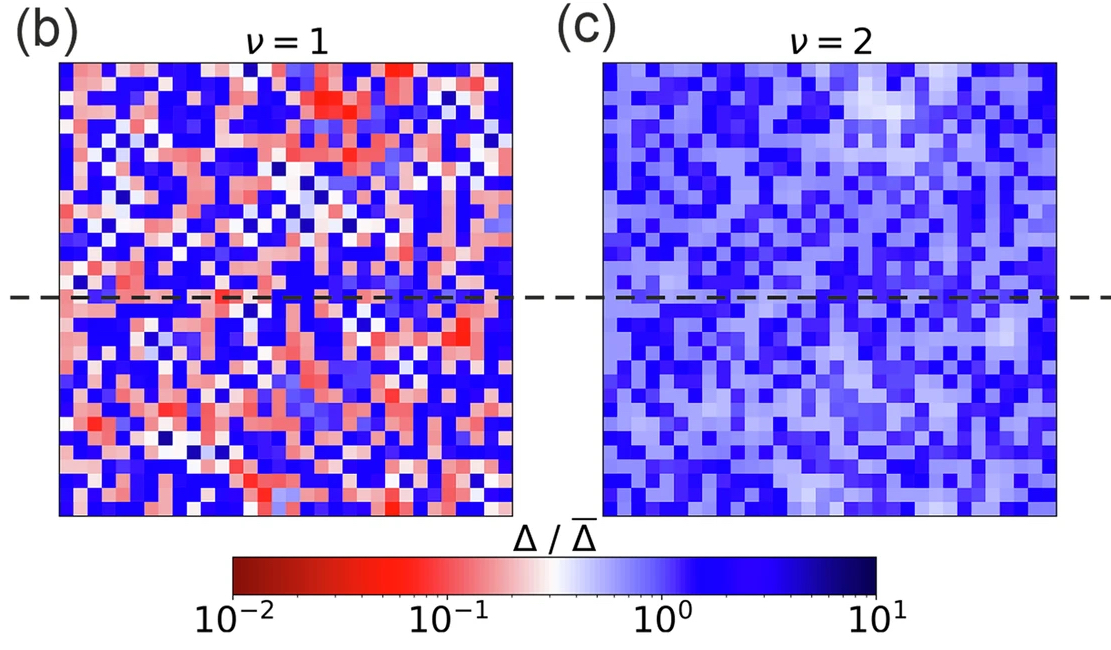
Calculations confirm that this approach is effective for various types of disorder, ranging from random impurities to specially engineered superlattices. It is particularly promising for multilayer materials, where clean and disordered layers can be alternated; for compounds based on magnesium and boron (MgB₂), in which one electronic band enhances local superconductivity while the other facilitates current flow; and for materials with flat electronic bands, where electron pairing occurs more readily. Graphene- and graphite-based systems are also considered promising, as regular superstructures can form that alter electronic properties and promote stronger superconductivity. In the future, this could enable the development of materials in which defects and impurities do not hinder, but rather enhance, superconductivity.
The study was conducted with support from the Russian Science Foundation (Project 075-15-2025-010) and the HSE Basic Research Programme, using the university's HPC cluster.
See also:

Neural Network Trained to Predict Crises in Russian Stock Market
Economists from HSE University have developed a neural network model that can predict the onset of a short-term stock market crisis with over 83% accuracy, one day in advance. The model performs well even on complex, imbalanced data and incorporates not only economic indicators but also investor sentiment. The paper by Tamara Teplova, Maksim Fayzulin, and Aleksei Kurkin from the Centre for Financial Research and Data Analytics at the HSE Faculty of Economic Sciences has been published in Socio-Economic Planning Sciences.
'Even among Geniuses, Luck Plays a Role in Winning a Nobel Prize'
Denis Bodrov studies particle physics and works at one of the four electron–positron colliders in the world. In this interview with the HSE Young Scientists project, he talks about his efforts to go beyond the Standard Model, discusses tau leptons, and shares his affection for Moscow.
Larger Groups of Students Use AI More Effectively in Learning
Researchers at the Institute of Education and the Faculty of Economic Sciences at HSE University have studied what factors determine the success of student group projects when they are completed with the help of artificial intelligence (AI). Their findings suggest that, in addition to the knowledge level of the team members, the size of the group also plays a significant role—the larger it is, the more efficient the process becomes. The study was published in Innovations in Education and Teaching International.
New Models for Studying Diseases: From Petri Dishes to Organs-on-a-Chip
Biologists from HSE University, in collaboration with researchers from the Kulakov National Medical Research Centre for Obstetrics, Gynecology, and Perinatology, have used advanced microfluidic technologies to study preeclampsia—one of the most dangerous pregnancy complications, posing serious risks to the life and health of both mother and child. In a paper published in BioChip Journal, the researchers review modern cellular models—including advanced placenta-on-a-chip technologies—that offer deeper insights into the mechanisms of the disorder and support the development of effective treatments.
HSE Scientists Develop Simulation Environment for Connected and Automated Vehicles
A team of researchers and students led by Vitaly Stepanyants, Lecturer at the School of Computer Engineering of HSE MIEM, has developed a solution implemented at the Laboratory of Computer-Aided Design Systems of HSE MIEM, headed by Alexandr Romanov and Alexandr Amerikanov. For the first time worldwide, this system enables detailed simultaneous modelling of both environmental perception by automated vehicles and the propagation of connected transport signals. To date, there are no open-source programs comparable to the proposed environment.
Using Two Cryptocurrencies Enhances Volatility Forecasting
Researchers from the HSE Faculty of Economic Sciences have found that Bitcoin price volatility can be effectively predicted using Ethereum, the second-most popular cryptocurrency. Incorporating Ethereum into a predictive model reduces the forecast error to 23%, outperforming neural networks and other complex algorithms. The article has been published in Applied Econometrics.
Administrative Staff Are Crucial to University Efficiency—But Only in Teaching-Oriented Institutions
An international team of researchers, including scholars from HSE University, has analysed how the number of non-academic staff affects a university’s performance. The study found that the outcome depends on the institution’s profile: in research universities, the share of administrative and support staff has no effect on efficiency, whereas in teaching-oriented universities, there is a positive correlation. The findings have been published in Applied Economics.
Physicists at HSE University Reveal How Vortices Behave in Two-Dimensional Turbulence
Researchers from the Landau Institute for Theoretical Physics of the Russian Academy of Sciences and the HSE University's Faculty of Physics have discovered how external forces affect the behaviour of turbulent flows. The scientists showed that even a small external torque can stabilise the system and extend the lifetime of large vortices. These findings may improve the accuracy of models of atmospheric and oceanic circulation. The paper has been published in Physics of Fluids.
Solvent Instead of Toxic Reagents: Chemists Develop Environmentally Friendly Method for Synthesising Aniline Derivatives
An international team of researchers, including chemists from HSE University and the A.N. Nesmeyanov Institute of Organoelement Compounds of the Russian Academy of Sciences (INEOS RAS), has developed a new method for synthesising aniline derivatives—compounds widely used in the production of medicines, dyes, and electronic materials. Instead of relying on toxic and expensive reagents, they proposed using tetrahydrofuran, which can be derived from renewable raw materials. The reaction was carried out in the presence of readily available cobalt salts and syngas. This approach reduces hazardous waste and simplifies the production process, making it more environmentally friendly. The study has been published in ChemSusChem.
How Colour Affects Pricing: Why Art Collectors Pay More for Blue
Economists from HSE University, St Petersburg State University, and the University of Florida have found which colours in abstract paintings increase their market value. An analysis of thousands of canvases sold at auctions revealed that buyers place a higher value on blue and favour bright, saturated palettes, while showing less appreciation for traditional colour schemes. The article has been published in Information Systems Frontiers.